Categories
Uncategorized

Module 4

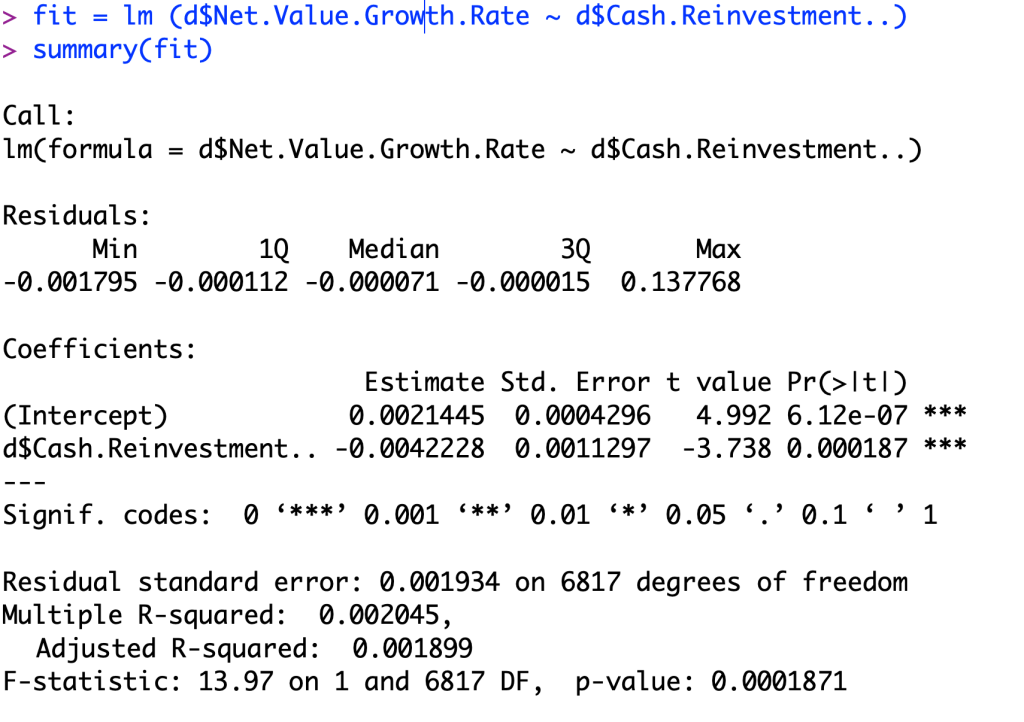
To build my linear regression model to predict a continuous variable, I used cash reinvestment % to predict Net Value Growth Rate. This was done to see if there was a correlation between the how much money a company reinvests into its business, and how much it grows.

The code that I inputted into R is as shown below:

After looking at this output, we can tell for every unit precent increase in the data, we see that if a company invests no money into the company, they are on average increasing in net value by 0.21% each year (the intercept). This seems to be very low for an average company. Now looking at the coefficient of our linear regression model line, we see that for every 1 unit (100%) increase there is a negative .0042 unit (0.42%) decrease (the slope of the linear regression line). This is highly irregular of a business and I will look into this more.

Categories
Uncategorized

Analyze data Pt. 1

I have switched up my databases and goals, I will be editing the past posts to match this data set and its goals.

Today we analyze the data for bankrupt businesses and seeing if we can determine if a business is going to go bankrupt.

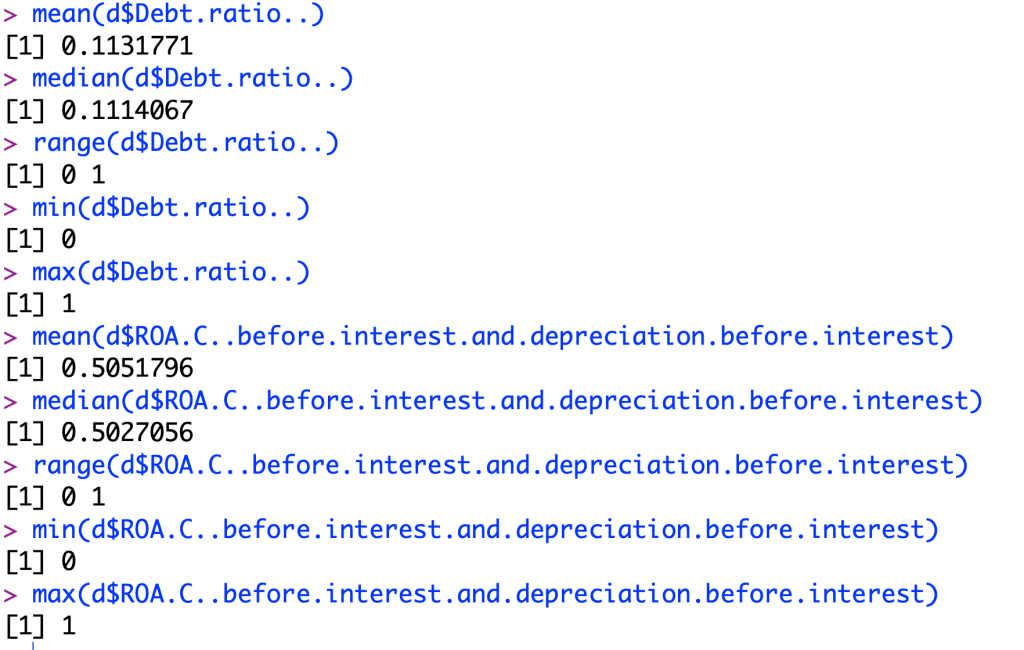
First I wanted to look at the means, medians, range, and min/max of the debt ratio and ROA of the companies listed in the dataset.

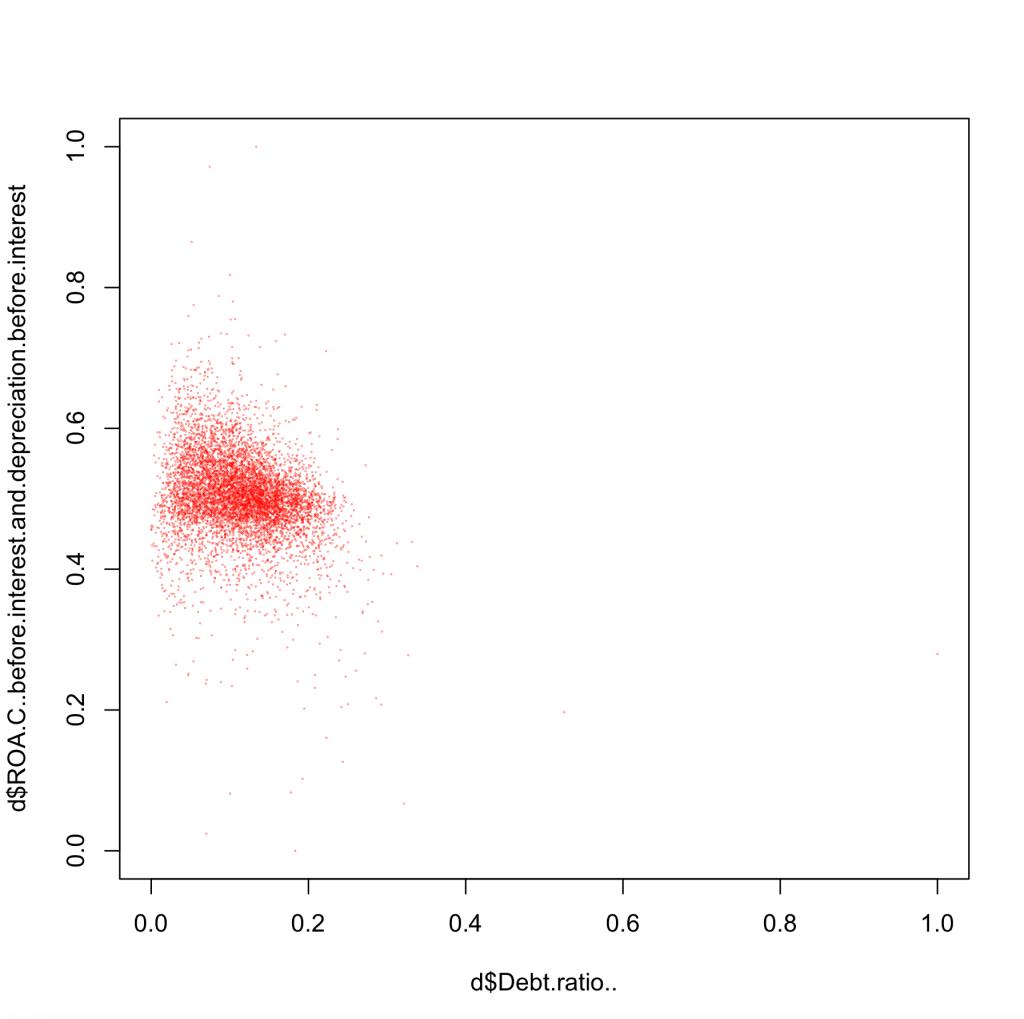
As I look at the Debt ratio, I see that the mean is a value of .113 and a max value of 1. I believe that those companies with a higher Debt ratio will be companies that are going to go bankrupt. I also looked at the Return On Assets (ROA) to see if there was a correlation between these metrics and failing businesses. I made a scatter plot of this to help show this metric, but I was not able to change the color of the data points to distinguish between bankrupt companies and non-bankrupt companies.

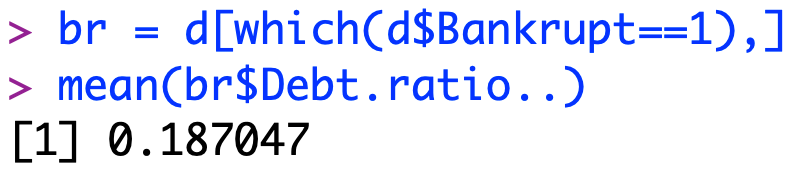
Looking back at the debt figure I used this code to find that the average Debt ratio of a failed company is significantly higher than living businesses.

I was able to use the Bankrupt business list to find the mean ROA of bankrupt businesses, which I can now compare to the non bankrupt businesses.

Next time I will attempt to question do companies that go bankrupt have a higher particular ratio than other businesses?

Categories
Uncategorized

Data Within Study

This data set from Kaggle aims to find a relationship between external factors of a student which are more likely to make them drink as a student.

This data set found lists each subject and some of the following information: sex, age, family size, address type, parental status, parent education, study time, failures, internet access, free time, and daily alcohol consumption among other things. There is a total of 382 students listed in this data set.

My goal of this data set is to find a relationship between those external factors and the excessive daily alcohol consumption of a student. This can help determine what students are more likely to partake in riskier activities like drinking. Not just to flag the students, but to determine what schools need more drinking-related education within their school to help combat the high predicted percentage of drinkers. This could help the community by decreasing the prevalence of drinking in the future society and make our population healthier.

Categories
Uncategorized

Welcome!

Welcome to my blog!

My name is Garrett Schlosser and this is my blog for my MISY262 class at the University of Delaware. In this blog I plan to focus on the statistical analysis of Student drinking, and variables that make a student more likely to consume alcohol. As this semester continues I will periodically update my statistical findings on student Alcohol consumption.

Categories
Uncategorized

My First Blog Post

Be yourself; Everyone else is already taken.

— Oscar Wilde.

This is the first post on my new blog. I’m just getting this new blog going, so stay tuned for more. Subscribe below to get notified when I post new updates.

Categories
Uncategorized

Introduce Yourself (Example Post)

This is an example post, originally published as part of Blogging University. Enroll in one of our ten programs, and start your blog right.

You’re going to publish a post today. Don’t worry about how your blog looks. Don’t worry if you haven’t given it a name yet, or you’re feeling overwhelmed. Just click the “New Post” button, and tell us why you’re here.

Why do this?

  • Because it gives new readers context. What are you about? Why should they read your blog?
  • Because it will help you focus you own ideas about your blog and what you’d like to do with it.

The post can be short or long, a personal intro to your life or a bloggy mission statement, a manifesto for the future or a simple outline of your the types of things you hope to publish.

To help you get started, here are a few questions:

  • Why are you blogging publicly, rather than keeping a personal journal?
  • What topics do you think you’ll write about?
  • Who would you love to connect with via your blog?
  • If you blog successfully throughout the next year, what would you hope to have accomplished?

You’re not locked into any of this; one of the wonderful things about blogs is how they constantly evolve as we learn, grow, and interact with one another — but it’s good to know where and why you started, and articulating your goals may just give you a few other post ideas.

Can’t think how to get started? Just write the first thing that pops into your head. Anne Lamott, author of a book on writing we love, says that you need to give yourself permission to write a “crappy first draft”. Anne makes a great point — just start writing, and worry about editing it later.

When you’re ready to publish, give your post three to five tags that describe your blog’s focus — writing, photography, fiction, parenting, food, cars, movies, sports, whatever. These tags will help others who care about your topics find you in the Reader. Make sure one of the tags is “zerotohero,” so other new bloggers can find you, too.
Design a site like this with WordPress.com
Get started